Skip to content

North Blue Nutrients / Controlled Environment Program

EnvironmentalsPrecision Climate + Root-Zone Management

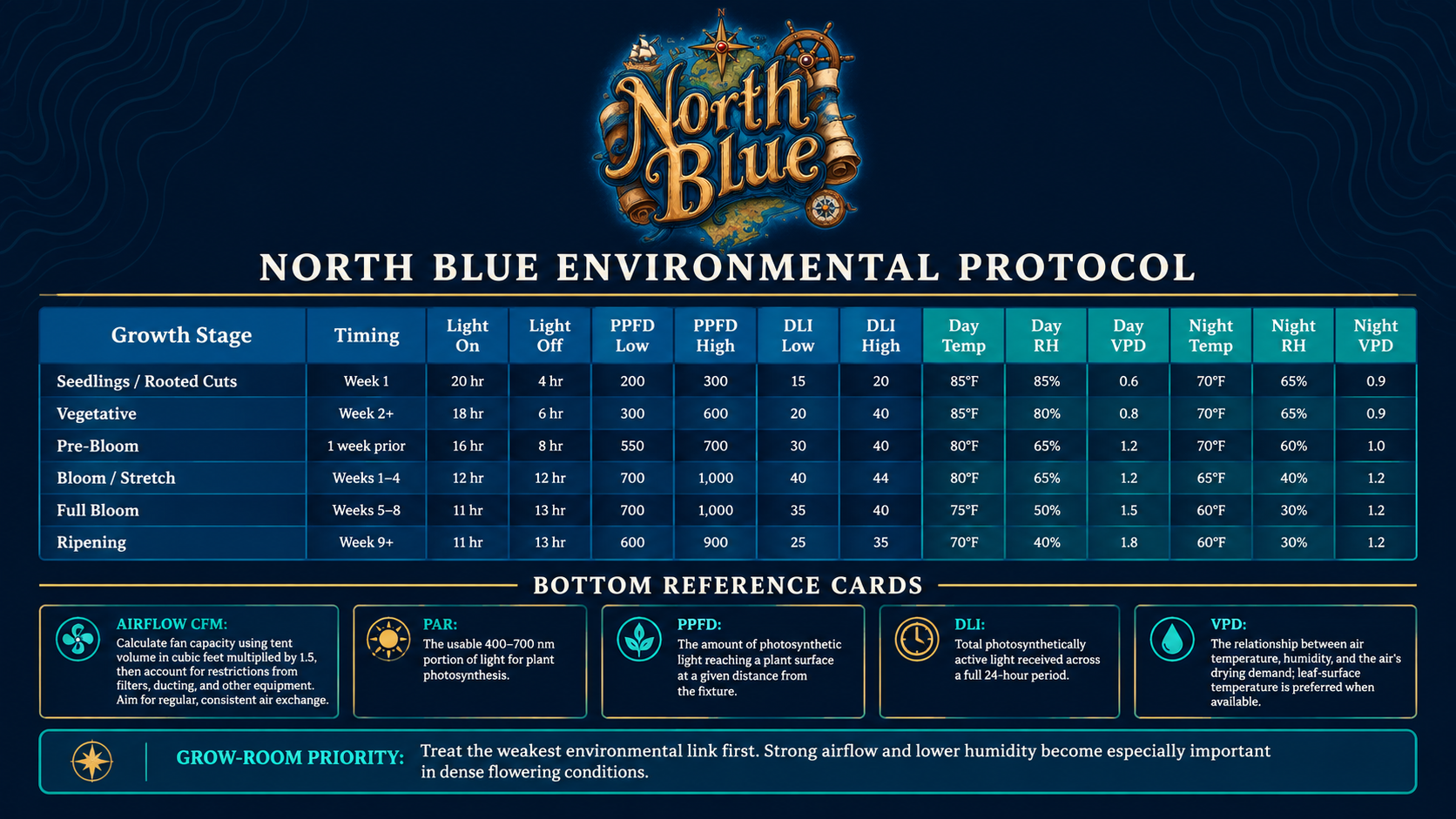
Your grow environment is the operating system behind every feeding, genetic, and cultivation decision. Start with the visual reference below, then build stable conditions around temperature, humidity, airflow, light, irrigation, and root-zone oxygen.

North Blue Nutrients Environmentals guide
North Blue Nutrients Environmentals Guide Full-width reference graphic — displayed at maximum practical size for clear, easy reading across desktop and mobile screens.

Build the Conditions for Performance

Environmentals are the operating system of a productive garden. Nutrients, genetics, and microbial inputs work more predictably when the canopy and root zone remain within stable, well-managed conditions.

Temperature and humidity influence transpiration, water demand, nutrient movement, disease pressure, and plant comfort. Air movement helps reduce stagnant microclimates, while an even irrigation strategy supports oxygen balance and biological activity around the roots.

Rather than chasing isolated numbers, focus on consistency. Use reliable sensors, watch day-to-night trends, and make small changes to one variable at a time. Stable conditions support stronger plant structure, efficient photosynthesis, balanced nutrient uptake, and resilient crop performance.

Core Environmental Pillars

The best environment is uniform across the canopy, root zone, and full light cycle. These pillars work together; changing one commonly changes the behavior of the others.

Canopy Climate

Temperature + Humidity

Maintain a consistent canopy climate that supports normal transpiration and avoids prolonged stress from extreme heat, cold, or humidity swings.

Air Exchange

Airflow + Circulation

Keep air moving gently above and below the canopy. Uniform circulation helps reduce still, humid pockets while supporting even leaf-surface conditions.

Light Management

Intensity + Uniformity

Match light intensity and photoperiod to plant age, cultivar, canopy density, and acclimation. Avoid abrupt increases that outpace water and nutrient delivery.

Water Strategy

Irrigation Timing

Water to media and plant demand—not a fixed calendar. Consistent dry-back and proper saturation protect root-zone oxygen and help avoid chronic stress.

Root-Zone Health

Oxygen + Moisture

Healthy roots require a workable balance of moisture, porosity, biological activity, and oxygen. Watch container weight, runoff behavior, and plant posture.

Data + Observation

Trend-Based Control

Log day and night readings, irrigation events, plant response, and equipment changes. Trends make it easier to find the real cause before changing inputs.

Control the Basics First

Do not correct every symptom with another input. Before adding more nutrients, supplements, or sprays, verify temperature, humidity, airflow, irrigation behavior, light intensity, and root-zone moisture.

Make gradual, documented adjustments and give plants time to respond. Environmentals provide a management framework, not a substitute for routine scouting, sanitation, appropriate equipment maintenance, or a complete fertility program.